
The Automated Web Browser That Collects Data
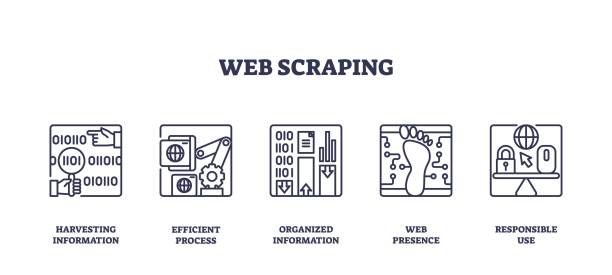
Web scraping is the automated process of extracting data from websites — visiting web pages programmatically, parsing the HTML to extract specific information, and storing the extracted data for analysis or use. It’s the technical mechanism behind price comparison websites, academic research that analyses large volumes of web content, business intelligence tools that monitor competitor pricing, and many other data collection applications that would be impractical to do manually.
The concept is straightforward: the same HTTP requests a web browser makes when visiting a website can be made by a program, the HTML content returned can be parsed to extract specific data points (prices, product names, contact information, news headlines), and this process can be repeated across hundreds or thousands of pages automatically. The technical implementation ranges from simple to complex depending on how the target website delivers its content.
The Legal and Ethical Landscape
Web scraping’s legal status is genuinely complex and context-dependent. The foundational US case (hiQ Labs v. LinkedIn, with multiple court rulings between 2017 and 2022) concluded that scraping publicly available information that isn’t behind a login wall generally doesn’t violate the Computer Fraud and Abuse Act. However, the terms of service of most major websites prohibit scraping, robots.txt files specify which paths crawlers should avoid, and rate limiting or IP blocking represents a technical ‘do not enter’ signal.
The practical legal guidance: scraping publicly available information that doesn’t require a login, for non-competitive purposes, at reasonable rates that don’t stress the target server, while respecting robots.txt, is generally defensible. Scraping information behind authentication (scraping logged-in content using credentials you didn’t agree to use for automated access), at rates that constitute a denial-of-service attack, or for purposes that directly compete with the source website’s core business model, is where legal and ethical concerns are most serious.
Simple Scraping: Requests and BeautifulSoup
For websites that deliver their content in server-rendered HTML (the HTML contains the data when the page first loads, without requiring JavaScript to run), Python’s requests library and BeautifulSoup provide a simple, effective scraping toolkit. Requests fetches the HTML of a URL; BeautifulSoup parses the HTML and provides methods to find and extract specific elements by their HTML tag, class name, or ID attribute.
The basic scraping pattern: import requests and BeautifulSoup, fetch a URL with requests.get(), create a BeautifulSoup object from the response content, use soup.find() or soup.find_all() to locate the specific HTML elements containing the target data, extract the text or attribute values from those elements, and store or process the extracted data. This pattern handles the majority of simple scraping tasks on static websites in 20-50 lines of Python.
JavaScript-Rendered Content: Playwright and Selenium
Many modern websites deliver content dynamically through JavaScript: the initial HTML is minimal, and the actual content is added to the page by JavaScript running in the browser after the initial load. A simple HTTP request that gets the initial HTML gets the shell without the content. For these sites, a browser automation tool — Playwright (from Microsoft, the modern choice) or Selenium (the older standard) — is required: these tools control a real (or headless) browser, allowing JavaScript to execute and the full page content to render before extraction.
Playwright provides cleaner async Python and JavaScript APIs than Selenium, handles modern browser features more reliably, and is the current recommendation for new scraping projects. The playwright.async_api module allows navigating to pages, waiting for specific elements to appear after JavaScript rendering, clicking buttons, filling forms, and extracting content from the fully rendered page state — enabling scraping of complex, interactive web applications that simple HTTP requests can’t handle.
Rate Limiting, Rotating Proxies, and Ethical Practice
Websites implement anti-scraping measures including rate limiting (blocking IPs that make too many requests too quickly), CAPTCHAs (requiring human verification for suspicious traffic), and bot detection (identifying browser automation through various behavioural and technical signals). These measures exist to protect server resources and business interests, and working around them aggressively crosses from scraping into adversarial behaviour that’s ethically and legally questionable.
Ethical scraping practices that reduce both blocking and ethical concern: add delays between requests (time.sleep() between requests to avoid overwhelming the server), respect robots.txt (check the target site’s /robots.txt and avoid paths that disallow crawlers), use a descriptive user agent string that identifies your scraper and provides contact information for the site operator to reach you, scrape during off-peak hours when server load is lower, and cache results to avoid re-fetching the same content unnecessarily. These practices produce scraping that’s respectful of the target server and more likely to succeed long-term than aggressive approaches that get blocked and require constant workarounds.